Sunday, 11 November 2012

Angelica Kauffman (1741 - 1807)


Angelica Kauffman self-portrait 1785

Swiss-born Angelica Kauffman was an artist child prodigy. As a teenager she was painting portraits of the European nobility. She spoke Italian, German, French and English. She played musical stringed instruments and was an accomplished opera singer. In mid-1760s London she was the darling of the portraitists counting royalty among her clients. Her alluring beauty had men throwing themselves at her feet.   But she was duped into marrying a confidence trickster posing as a count. She got out of the marriage only when the husband died in 1780. She married a second husband in 1781 and spent the last 25 years of her life in Rome, where she died on 5 November 1807.

Thursday, 8 November 2012

Louis VIII - the French king who refused doctor's orders


“Your Majesty is dying. The only remedy for you is to deflower this young virgin”. 

Such was the proposition made to Louis VIII of France on 8 November 1226 as he lay on his death bed. But the king replied that he was in love with his wife, Blanche de Castille, whom he had married when both were twelve years old, and must therefore refuse his physician’s thoughtful advice.

Louis had the cognomen ‘the Lion’, and had fallen sick on his way back to Paris from the Crusades in the south of France. He was struck down with a fever and debilitating diarrhoea and was probably suffering for dysentery, a common illness of soldiers at the time, though some think he may have been poisoned. On 3 November he took to his bed and became delirious. His doctors consulted and diagnosed a severe case of sexual abstinence due to several months of campaigning, and that the remedy was a night of passion with a young virgin. As reported by Guillaume de Puylaurens: 

‘…. coming back from the Crusades in Albigeois the king fell ill and they said he could be cured if he saw a woman …. His faithful companion Archambaud de Bourbon chose a beautiful young girl and had her placed in his bed while he was sleeping. Upon waking the king asked the girl what she was doing in his bed. She replied that she was there to help cure him of his sickness. He thanked her for her kindness and said that he must refuse the remedy as he did not wish to commit a mortal sin.’

He died several days later - 8 November 1226, at the age of 39.

No-one at the time blamed Louis’s fidelity as the cause of his death. Instead, rumour-mongers pointed the finger at Thibaud de Champagne, whom they accused of poisoning the king because of his mad passion for Blanche. But Thibaud had a cast iron alibi, as had left the royal army several months before the king’s death. 

Louis was succeeded by his twelve-year old son, Louis IX, who was to become known as Saint Louis, and Blanche assumed the title of Regent.

Wednesday, 7 November 2012

Place Masséna, Nice


Place Masséna c. 1905

Nice's beautiful Place Masséna owes its name to Marshall André Masséna, a lieutenant in Bonaparte's Italian Army. He saw victory in Zurich in 1799, distinguished himself at the siege of Genoa in 1800, defeated the Austrians at the Battle of Caldiero in 1805, and was conqueror of the Kingdom of Naples in 1806. In 1804 he was made Marshall of the Empire, in 1808 he became Duke of Rivoli, and in 1809 Prince of Essling. But he fell from grace after reverses in Portugal in 1810. More interested in pleasure than in patriotism, he aged prematurely and died in 1817.

Carnival on Place Masséna c. 1900

An important date for Nice, and for the Place Masséna is 26 May 1832 as this is the day that the king Charles-Albert established an institution with the task of creating an urban plan which would determine the shape of the modern city. This led in 1844 to the creation of the Place Masséna with Boulevard Barthélemy (later Avenue de la Victoire, now Avenue Jean Médecin) to the north. 

And in 1928, Jean Médecin, an energetic and stubborn man, was elected mayor of Nice, and oversaw the enlargement of the square to what it is today - a vibrant crossroads in the heart of la belle ville de Nice.

Strollers on Place Masséna today

The History of England from 1625 - 1689


Portrait of Charles I
by Anthony van Dyck
In 1625 James I of England is succeeded by his son Charles I. If the Scottish James did not understand the English, his less intelligent son understands neither the English nor the Scots. Moreover, he has Catholic sympathies, marries a Catholic princess, and favours the High Church party of William Laud. This puts him into conflict with an increasingly Puritan Parliament. The king argues with Parliament, and for eleven years from 1629-40 dispenses with Parliament altogether. Laud persecutes the Puritans and many seek refuge in New England where they found Massachusetts and Connecticut. When Charles tries to impose the Laudian Church on Presbyterian Scotland the Scots rebel and occupy parts of northern England. Parliament meanwhile passes a series of Acts to limit the power of the crown and make it financially dependent on Parliament. Then Parliament introduces the Militia Bill transferring the control of the military to Parliament. Charles tries to arrest leading members of the House, but they escape and train-bands rise in support. 
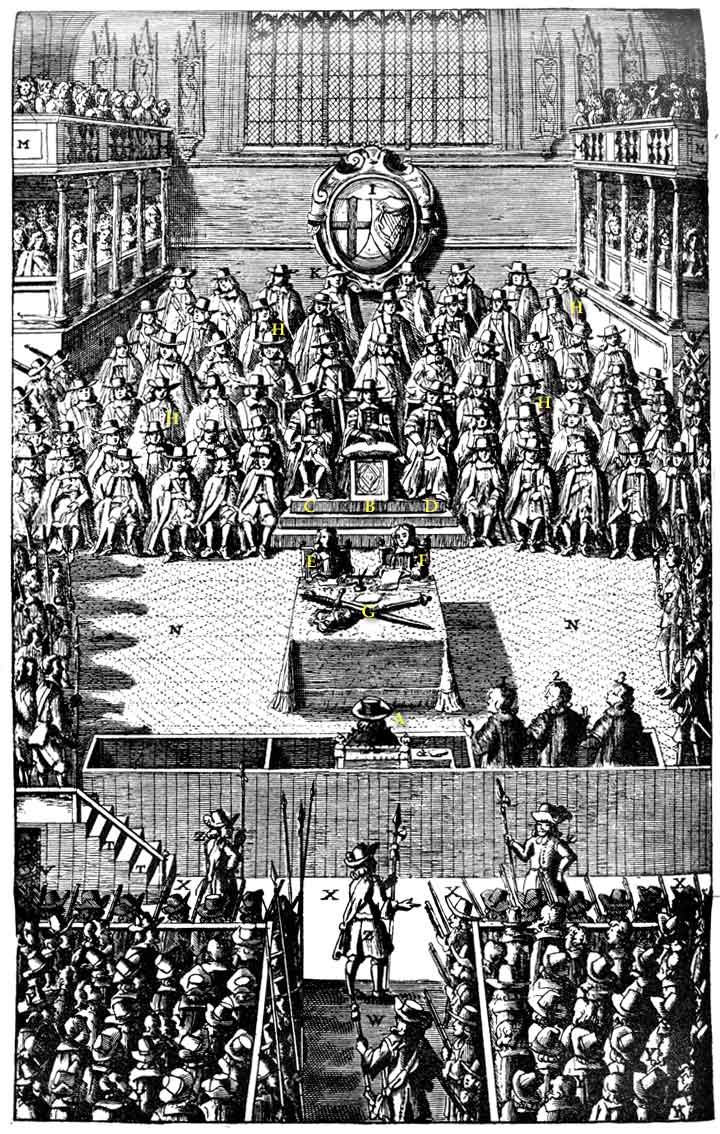
Charles is put on trial
A week later the king flees his palace and the Civil War begins. At first things go the King’s way. Then Parliament makes a covenant with the Scots, and in 1644 a combination of Scots, Roundheads and Cromwell’s new cavalry defeat the Royalists at Marston Moor. Parliament then enlists a 20,000 force New Model Army commanded by Sir Thomas Fairfax and Cromwell, and in 1645 it routs the Royalists at Naseby and Langport. Charles surrenders to the Scots and is handed over to Parliament. The king tries to sow dissension among his enemies, but is seized by Cromwell, and a Second Civil War begins pitting Cromwell against an unlikely alliance of English Presbyterians, Scots and Royalists. Cromwell quickly defeats his opponents and purges Parliament of its Presbyterians, leaving only a Rump of sixty Independents. Charles is tried for treason and executed on 30 January 1649. But the regicide is a political blunder. Parts of the army mutiny, there is foreign hostility, Ireland rebels, and the Scots proclaim Charles II as their king. Cromwell responds with ruthless efficiency, shooting mutineers, crushing the Irish, and routing the Scots. He builds a naval fleet to secure the colonies and makes 
Charles II in Coronation robes
by John Michael Wright
England mistress of the seas. Except for Catholics and High Churchmen, there is greater religious freedom, but Cromwell argues with the Rump and military dictatorship follows. Cromwell dies in 1658 and England falls into the hands of rival generals. But General Monk marches from Scotland and occupies London, and a newly declared free Parliament restores the monarchy. In 1660 Charles II returns from his long exile, putting an end to the Puritan Republic, in which theatres and other popular entertainments were banned, but which allowed free expression of thought without fear of persecution by Church or state, a privilege enjoyed to this day. Charles is a fun-loving, unscrupulous libertine. But his Catholic sympathies put him in conflict with Parliament, which also wants to retain its control of taxation. But the first decade of Charles’s rule is 
marked by disasters. In 1665 the ‘grievous Visitation’ known as the Great Plague decimates the population of London. In 1666 the Great Fire of London destroys the capital, including the Gothic cathedral of St. Paul’s. And in 1667 the Dutch sail up the Thames in the final act of the Anglo-Dutch naval war which ends in an English defeat. Also in the 1660s Admiralty Clerk of the Acts Samuel Pepys begins writing his famous Diary. In 1672 another Dutch war begins, and in the same year Charles issues a Declaration of Indulgence granting tolerance to all including Catholics. This is too much Parliament, particularly as the heir to throne is Charles’s brother James, the Duke of York, and a Catholic. The king is forced into a U-turn, and for the first ever a monarch has to accept a minister from Parliament, the Earl of Danby, a staunch Anglican who had arranged the marriage between the Duke of York’s Protestant daughter Mary, to William of Orange, Charles’s nephew. In 1678 the informer Titus Oates swears to have uncovered a Popish plot to murder the king and put the Catholic Duke of York on the throne. Innocent Catholics lose their lives as a result of Oates’s 
Period playing card
depicting the execution of
the Duke of Monmouth
treachery. Parliament passes the Habeas Corpus Act, and a Bill to prevent James’s succession. But the House of Lords rejects the Bill and the king dissolves Parliament. Civil war looms once more. Meanwhile the age of experimental science has begun. Christopher Wren is Professor of Astronomy at Oxford, and Isaac Newton Professor of Mathematics at Cambridge. Then in 1685 Charles dies and his brother is crowed James II. A forlorn rebellion led by the Duke of Monmouth is ended at Sedgemoor, the site of the last battle ever to be fought in England. The new king permits Catholics into the army and introduces a Declaration of Indulgence that gives toleration to Catholics. Then James’s Catholic wife gives birth to a son thus assuring a Catholic succession. Disenchanted Whigs and Tories ask William of Orange to save England. William lands at Brixham in November 1688 and James is forced to flee to France. William is crowned king in 1689 and England once more has a Protestant monarch. 

Saturday, 3 November 2012

Alexander the Great, King Porus of India, and the Battle of the Hydaspes


Battle of Alexander and Porus
by Louis Watteau de Lille
 'Porus, gathering forty beasts around him, drove at the enemy with the whole mass of his elephants and inflicted grievous losses. Moreover, he himself was far superior to his companions in arms and in physical strength ... so that he hurled his javelin with the strength of a catapult.' Diodorus Siculus, 1st Century BC.

In 326 BC Alexander marched his army against the Indian King Porus, electing to cross the Hydaspes River during the summer monsoon. He succeeded in crossing with 6,000 infantry and 5,000 horsemen. Facing him were 300 chariots and 200 war elephants deployed by Porus as his front line. But the chariots proved useless in the sodden ground of the battlefield, and Porus, wounded several times, was forced to surrender. 

'Losses in the Indian infantry amounted to 20,000, or very nearly, the cavalry lost around 3,000, and all the chariots were destroyed. Porus's two sons were killed. So were the commanders of the elephant and chariot regments...'Arrian Campaign of Alexander, 1st Century BC.

Triumph of Alexander the Great
by Gustave Moreau

'
'The little Indian valley where his immense and magnificent throne was established contained all of India, the temples with their magnificent roofs, the glaring idols, the sacred lakes, the underground caves full of mysteries and terror.' [Gustave Moreau]

Friday, 2 November 2012

Pope Alexander VI and those wild Vatican nights


A Glass of Wine with Caesar Borgia by John Collier (1893)
Lucrezia Borgia with father Rodrigo (Pope Alexander VI)
and brother Cesare.

On the night of 31 October 1501, Pope Alexander VI organised a wild party to celebrate the forthcoming marriage of his daughter Lucrezia Borgia to Alfonso d'Este, the future Duke of Ferrara. Among the guests is Vatican chaplain Johann Burchard, who records the night's events in his diary.

It begins with a banquet of food and drink, then Alexander gives the signal for 50 dancers to enter and perform lascivious, pagan dances for the titillation of the guests. The men hurl obscenities and the dancers start to remove their clothes. Servants throw chestnuts into the air, and the dancers get down on all-fours to gather them up.

The Supreme Pontiff then calls for a virility contest with prizes for those guests that display the most ardour among the naked courtesans. The laymen guests remove their trousers, the priests remove their cassocks, and the courtesan-dancers open their legs. Later, exhausted and ecstatic, the winners collect their prizes.

Some may have found the proceedings to be undignified and in bad taste, but not Alexander. From his early years in Spain as Rodrigo Borgia he was always a ladies' man, and he saw no reason to change when, in 1456, at the age of 25, he was called to Rome by his uncle Pope Callixtus III. Though not yet ordained a priest, he was made Vice Chancellor of the Church, essentially number two at the Vatican. And even when made a priest in 1458, he didn't forego the ladies. Because as well as providing pleasure they also provided children, and for an ambitious cardinal children were good for business, as they enabled him to form lucrative liaisons with noble Italian families, a necessary step on the promotion ladder to the papacy.

Rodrigo became pope in 1501 and took the name Alexander VI. One of his first acts as pope was to issue a bull of excommunication against printers who should publish 'pernicious doctrines' about the Church, or put another way, who should dare to engage in intellectual discussion on ecclesiastic matters. But he also decided that it would no longer be prudent for him to sire children. And if one of his mistresses should happen to give birth, then he wouldn't recognise the child as his own. A pontifical nicety that his predecessor Innocent VIII didn't concern himself with, openly recognising two children among the dozen that he probably had. Alexander chose instead to consolidate his power by marrying his daughter Lucrezia to a man - several men, in fact! - of noble birth. 

The first was Giovanni Sforza, but Alexander had the marriage annulled on the grounds of Giovanni's 'impotence'. Giovanni responded by accusing Lucrezia of parental and fraternal incest, a rumour which has stuck to the Borgias to this day.

After the Banquet of Chestnuts, as the party of 31 October 1501 came to be known, Lucrezia married Alfonso d'Este, and they had many children, though it did not constrain Lucrezia from entertaining several lovers. As for her father the pope, he died in 1503, possibly of malaria or the plague, and there is also the suggestion that he was accidentally poisoned by his son Cesare. 


Thursday, 1 November 2012

Flies


"London, did ye say? I'll give
thee London!"
What wouldn’t we give to have been a fly on the wall at some of the dramatic (and melodramatic) moments in history. The day, for instance, that Shakespeare announced to his wife Anne that he was quitting the family home and shooting off to London to seek his fame and fortune. Would the Prince of Words have found the phrases necessary to mollify any discontent on the part of his old wench? Or would he have been too busy dodging the items of crockery that said wench was hurling his way?


"Adieu, my brave comrades,
and zee best of luck!"
The fly has a compound eye made up of several thousand lens, so very little would have escaped its beady attention. Consider the dramatic moment outside Moscow in 1812, when Napoleon made the commander's heroic decision to abandon his retreating army and scoot off to the arms of Maria Walewska, his Polish mistress in Warsaw. Did he, perhaps, address his army in the following terms: “My loyal troops and comrades in arms. As you know, zee Russian army iz approaching, and zay are not in a good mood. So I ‘ope you do not mind if I leave you to it while I go to Varsaw for a bit of you know what. So I'll just bugger off, if zat iz all right viz you?” Did he then beat a hasty retreat amid cries of “Vas-tu faire foutre!”, “Saligaud de merde!” and other Gallic expletives? 

"I got the sucker! It's right
there. There it is!"
Of course it's impossible that the humble fly could never become a chronicler of human history. But nor would it ever want to be. All that a fly wants is the same that all of nature wants, and probably most human beings, too, and that's to be left alone. So pity that poor fly that dared that time to wander into a TV studio during an interview with a certain President of the United States of America, and then proceed to put on a free display of aerial acrobatics, including the trick - how does it do it??? - of landing upside down on the ceiling, only to end its days a dead trophy on the studio floor.

Flies, in fact, are our friends. They feed on decaying material thus speeding up the nutrient cycle and creating richer soil for our food to grow in. Without their help we would be up to our necks in excrement. They also provide an essential food supply to many birds, without which their numbers would dwindle and a part of nature with it. So our enjoyment of the world around us would be seriously lessened were it not for flies.