Sunday, 4 September 2011

Mr Anonymous : Edward de Vere, 17th Earl of Oxford (1550-1604)

Edward de Vere, 17th Earl of Oxford
by Marcus Gheeraerts the Younger
"Here's one I wrote earlier, guv".  [Edward de Vere]
So Hollywood has a new 'Shakespeare' movie coming out. Well, well, nearly 400 years dead and still good for business! The latest well-hyped offering is titled Anonymous and is based on the life of the 17th Earl of Oxford, Edward de Vere (1550-1604), whom the film hails as the ‘true author’ of Shakespeare’s plays. This is the also the view of a handful of crackpot Shakespearean actors and academics, though it may have been thought that the fact that de Vere inconveniently died before many of the plays had been written (Macbeth, The Winter’s Tale, Coriolanus, The Tempest) might have deterred them just a little.


One of the arguments they put forward against Shakespeare's authorship is that he did not attend a university and so would not have had the classical education needed to write the plays, many of which are based on stories from the Roman writer Ovid. But Shakespeare almost certainly attended Stratford Grammar School (the school records no longer exist, but Shakespeare's father was a town councillor and it was a 'perk' of all councillors that their sons were educated at the grammar school). They were called grammar schools because what they taught was Latin grammar, and once the boys had mastered the language all the lessons were in Latin. Among the books they studied was the works of - you guessed! - Ovid, and it is estimated that when the boys left the grammar school they would have had the equivalent of a classics degree from a modern university.


Shakespeare also seemed to reminisce on his grammar school days in his play The Merry Wives of Windsor, in which we see a boy, appropriately called William, being given an amusing Latin lesson by his Welsh school master, called in the play Evans. It is known that when Shakespeare was a boy there was indeed a Welsh master teaching at the grammar school.


Shakespeare's dedication in
The Rape of Lucrece to his
patron, the Earl of Southampton
De Vere was a minor poet and writer of song lyrics. Among his lyrics was Come hither, shepherd swain, which was published under his own name: Earle of Oxenforde. So if he published poems under his name, why not plays, too? It is contended by his supporters that the writing of plays was regarded as a lowly profession and certainly not one to which a man of noble birth could associate his name. But Shakespeare also wrote poems. Is it not strange that the earl should acknowledge his authorship of his own trivia, but not of Venus and Adonis and The Rape of Lucrece, which are regarded as poetic masterpieces?


The fact is that no one in Shakespeare's lifetime ever doubted that he was the author of the plays. Not the Stationer's Office, which approved books for publication; not the Master of the Revels, the booking agent for court performances of plays; not  his friends and partners in his theatre company; not rival dramatists, such as Ben Jonson, a man famed at the time for his learning and erudition (though like Shakespeare he had no university education). The authorship fashion only arose in the Nineteenth Century, over 200 years after Shakespeare's death, when the Victorians, in search of a national hero, lauded him as a universal genius and a man of family values (yes, it's a good joke!), indeed as a demi-god. But if you put someone up on a plinth in that manner then sooner or later someone's going to want to knock you off. The more so if there's money to be made (conspiracy theorists, publishers, film makers, Mein Herr academics, etc., etc., etc., etc.)


The film also casts de Vere as the incestuous lover of Queen Elizabeth, so it obviously has its tongue firmly in its cheek. But how many Oscars will it win, that is the question.


Wednesday, 31 August 2011

Notre Dame de la Garde, Marseille

View from the Gare St Charles down le Grand escalier with the  basilica on the far horizon


Atop the highest point in the city, overlooking the Vieux Port (Old port), stands Marseille's most striking landmark, the majestic neo-Byzantine basilica of Notre Dame de la Garde.


Arriving in the city by train, your first sight of the edifice is from the top of le Grand escalier, the broad steps that lead down from the station to the city spread at its feet. From this viewpoint the basilica is a mere silhouette on the horizon, and between you and it, hidden in a cove, is Marseille's Old Port and the site of the original Greek settlement from circa 600 BC.


Descend the steps with their striking sculptures and follow the Boulevard d'Athènes until it reaches a crossroads with La Canebière, the famous road which English sailors in the early 20th century dubbed 'the can o' beer', by virtue of the large number of bars that could be found there. La Canebière leads straight to the Vieux Port, and then onwards and upwards to the 'guardian and protector of the city', the name given to the basilica by the good folk of Marseille.


Le Vieux Port with the basilica on the hill
The basilica was constructed between 1853-1864. Although not among the largest of Catholic basilicas, what distinguished it, aside from its stunning location, is the height of its statue of the Virgin Mary, which stands at 23.7 metres (approx. 78 feet) including the pedestal, and which weighs around 10,000 kilos. To get there it's either a hard slog up the steep streets, a tourist ride in le petit train, or a municipal bus ride on the number 60 from Cours Jean Ballard.


Looking out from the basilica towards the Château
d'If, the small island on the left
And once there the views are magnificent! You can look down onto the Vieux Port and onto Marseille's other basilica, the Cathedral of Sainte-Marie-Majeure de Marseille. You can see the fort of the French Foreign Legion with its images of Beau Geste. And looking out across the white statue of St. Veronica and the Passion of Christ you can see in the distance the Château d'If, the island prison of Edmund Dantès, the romantic hero of Dumas' classic novel of revenge and justice, The Count of Monte Cristo. 


Not to be missed also is the enormous vaulted crypt measuring 30.15 metres x 13.60 metres (99 ft x 45 ft) and which houses a multi-coloured crucifix dating from the 16th Century, and a sanctuary dedicated to the Virgin with its golden mosaics. 


Tuesday, 16 August 2011

"Quick! Quick! The Mona Lisa. I'm double-parked!"


Whether or not the Louvre art museum in Paris is the best in the world is a matter of debate and local pride and prejudice, but it is apparently the most visited, and many visitors will be there for one reason only, to see it's most famous attraction, the Mona Lisa by Leonardo da Vinci.


It was painted some time between 1503 and 1519 and is variously known as La Gioconda, La Jaconde, and Portrait of Lisa Gherardini, wife of Francesco del Giocondo. Though now regarded as the most famous painting in the world, it was not generally known until the middle of the Nineteenth Century, since when its reputation has soared, and is now an unmistakable icon of western art.


In 1911 the picture was stolen and suspicion fell on two of the leading artistic figures of the time, the poet Guillaume Apollinaire and the painter Pablo Picasso. In the event the culprit was discovered to be someone much more banal, a certain Vincenzo Peruggia, an employee at the Louvre and an Italian patriot who wanted to see the painting returned to its native land. He was only discovered when he tried to sell the work to the Uffizi in Florence.


If you're planning on visiting the Louvre to see Leonardo's masterpiece please remember that many, many other people will have had the same idea, so don't expect to rub noses with the enigmatic Florentine lady. It's also very small, only 30 inches x 21 inches (77 cms x 53 cms) so those opera glasses may come in handy when you're peering at it from 50 feet distance.


"Out of the way! I've only got half a day and I've got the Notre Dame, the Eiffel Tower and the Centre Pompidou whatever that is still to do!"
[picture Wikipedia]


Saturday, 13 August 2011

Biker Babes Goin' Wild in Valence

200 kms from Valence a starlet poses at the Cannes Film Festival


A look at Valence (Drôme, France) from a political, economic and social standpoint, and definitely not dumbed down.


In order to respond to a mean, nasty, malicious and low-minded comment that this blog is dumbing down, we are now presenting this wholly serious posting on the French town of Valence, where I once spent 15 miserable hours due to the rain which never stopped the whole time, with the result that I left the place as ignorant as when I arrived.  So I'm now going back, digitally speaking, with the help of information and images graciously borrowed from the Internet, for a serious look at the socio-politico-economic activity of this important and vibrant community.


Anne-Sophie Lapix
We'll begin with the geography. Valence is a commune in the south-east of France and a prefecture in the department of the Drôme in the Rhône-Alpes region. It is the fifth most populated commune of the region with a population of 64,484 at the 2008 census. It is often referred to as 'the gateway to the South of France'. The current mayor is Alain Maurice of the P.c.f., the French Socialist Party, and the party of the beautiful Ségolène Royale, who I recently saw being interviewed by the ravishing Anne-Sophie Lapix. Mlle Lapix is a political science graduate, a trained and highly professional journalist and interviewer, with a sweet smile and a terrific pair of boobs.

Biker Babe contemplates 
what more she can do to 
help her community
The economic activity of Valence is primarily in the metal, textile, jewellery and agricultural sectors and many high-tech companies have facilities in the region. It has a highly developed transport infrastructure including a central train station which is served by the TGV high speed train from Paris to the Mediterranean. The city also has a popular bike sharing scheme. And in common with many continental cities, particularly in the south, there are lots of sexy, young biker babes wending their way through the traffic astride motor bikes and scooters, anxious to do their bit to ease their city's traffic congestion and thereby aid the economy of the community in which they live.


Ursula Andress, one of
Valence's most
famous non-natives
The commune has a lively and extensive intellectual and educational fabric which includes an engineering school, an Institute of Technology, as well as annexes to three universities, and various miscellaneous specialised schools. Among its most famous natives are Sébastien Chabal of the national rugby team; Bertrand and Guillaume Gille of the national handball team; and Jacques Tardi, comic strip artist. Not native to the commune is Ursula Andress, who was born in the Swiss city of Ostermundigen in the canton of Bern, and who gained overnight fame as Honey Ryder in the Bond film Dr No, in one of movie history's most iconic and memorable scenes in which she emerges from the sea looking stunning in a white bikini. 


The city also has a rich history, being ruled variously by Romans, Alans, Franks, Arabs of Spain, emperors of Germany and counts of Valentinois and of Toulouse. It has a cathedral with an apse that was rebuilt in the 11th century and consecrated in 1095. So it is a place with a fascinating past, but one which also has an active and important role to play in the present socio-politico-economic drama being enacted in the crisis-ridden world around it. So let's hear no more talk of dumbing down. This is a serious subject we've been discussing here. That's what we think, and Betty Boop does, too. Right, Betty?


Thursday, 11 August 2011

Piccadilly Circus, London


Piccadilly Circus in 1896 with Eros
statue on the left


They used to say that if you stood at London's Piccadilly Circus long enough then you would bump into everyone that you'd ever met in your life. It is not only the centre of London (though technically this is the nearby statue of Charles I mounted on a horse on the south side of Trafalgar Square), in former times it was also regarded as the hub of the Empire.


Of course one thing that you won't find there is a circus, at least not in the modern sense of the word, viz. a travelling company of performers. It is a circus in the original Middle English sense of a rounded open space where several streets converge, and which comes from the Latin for 'ring or circus', with echoes of an ancient Roman arena for equestrian and sporting events.


At the centre is the Shaftsbury Memorial Fountain with its famous statue of Anteros, in Greek mythology the god of requited love, though  the figure on the fountain is popularly known as Eros, the god of sensual love, known to the Romans as Cupid. 


Beneath the circus is the Piccadilly Circus tube station which in 2006 celebrated its 100th anniversary. In 1986, along with Bond Street tube station, it was the setting for a video to promote Paul McCartney's record Press, and featured Macca walking around the station. It has since become a place of pilgrimage for McCartney fans anxious to walk in his footsteps and be McPressed.


But perhaps Piccadilly Circus's biggest visitor attractions are its neon lights and its atmosphere. There is common saying to describe a place which is very busy - we say that it is 'like Piccadilly Circus in here'. And with its crowds of tourists and Londoners nowhere is more like Piccadilly Circus than Piccadilly Circus. And if you haven't been there already, don't worry, because one day - you will!


Saturday, 6 August 2011

Toulouse-Lautrec by Maurice Guibert


Henri de Toulouse-Lautrec photographed by Maurice Guibert (1856-1913)


Kurt Schwitters (1887-1948).

Das Undbild (1919)
Kurt Hermann Eduard Karl Julius Schwitters was a German artist whose career spanned Dada, Surrealism, sculpture and graphic design, though he is best known for his Merz Pictures collages and his Merzbau.


He started out as a post-impressionist until his work assumed a darker tone and moved towards expressionism. His first collages appeared in 1918 constructed of everyday objects. He gave his work the word Merz, a meaningless word which he derived from the German kommerzbank (commercial bank). He produced a periodical, also called Merz, with each issue devoted to a specific artistic theme. And he wrote poetry with the emphasis on the sounds that the words made rather than on their sense or meaning.


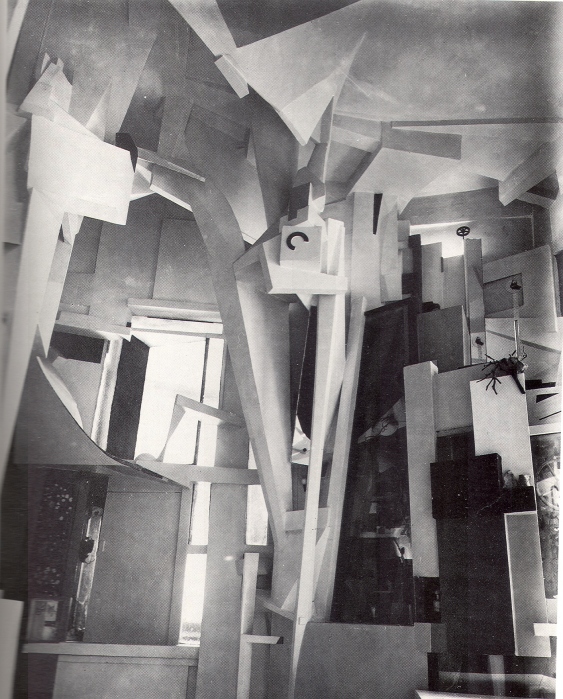
His most famous work, and one of the legends of modern art and which the artist himself described as his life work, is his Merzbau (Merz building), an architectural-sculptural project which extended over several room of his house in Hanover. He began the project in 1923 and continued working on it until he fled Nazi Germany in January 1937. In 1943 his house and his creation were destroyed in an Allied bombing raid.


The artist fled Norway in 1940 when it was occupied by the Germans, and came to Scotland and then England, where he died in 1948. 


Merzbau photographed in 1933